Assemblable Barth Sextics
silviana amethyst
Winter 2023-24
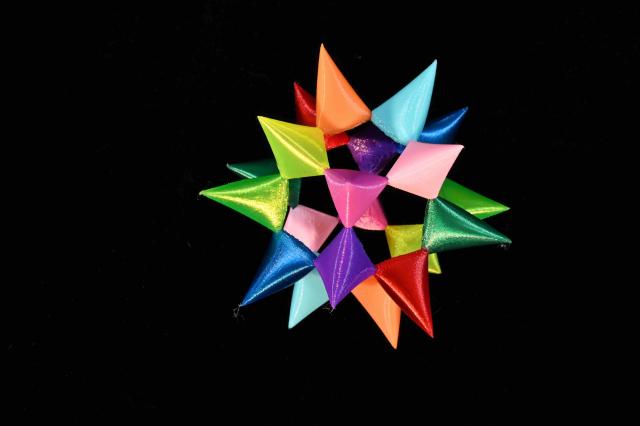
First I present this unedited photograph of an assemblable Barth Sextic, where colors are numbers of plugs / sockets. This is a random assembly of five each 0’s, 1’s, 2’s, and 3’s. When I say “random”, I mean I just did whatever came to my mind as I put it together.
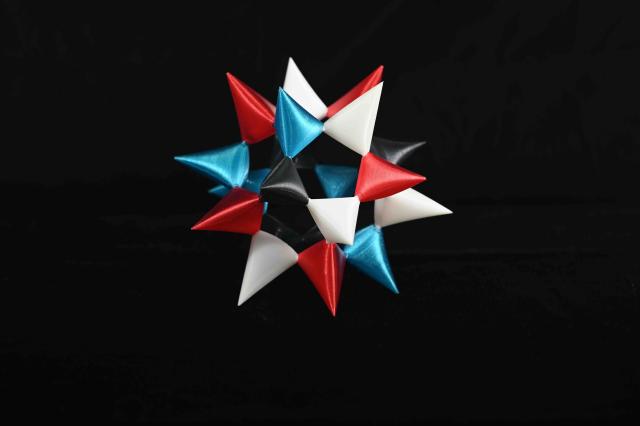
| Color | # plugs |
|---|---|
| Red | 0 |
| Black | 1 |
| Blue | 2 |
| White | 3 |
(aside: I find the plugs easier to count, which disappoints me as a post-op trans woman)
I made this set of pieces during the Illustrating Mathematics semester program at ICERM in Fall 2019. That semester was incredible and forever changed my career. If you find me at a conference, it’s likely I have this set with me. Ask me and you can play with it!
Symmetries 
I’ve been working in late 2023 to make snap-together models illustating all of them. I completed the rotations, antipodal, tetrahedra, and cube, but did not complete the mirror (I ran out of time before JMM 2024, and it would take six days to print the 12 models to make the mirror symmetry).
The Barth Sextic has 120 affine symmetries:
- 2-fold rotational about pairs of node joining pieces
- 3-fold rotational about tips of antipodal pieces
- 5-fold rotational about centers of antipodal pentagons
- Mirror (uncomplete so far)
The Barth Sextic additionally has some geometry hiding in it:
- tetrahedra
- cubes
- antipodal symmetry / projectivity
2-fold 
Uses ten colors. Rotation around nodes joining pairs of cones.
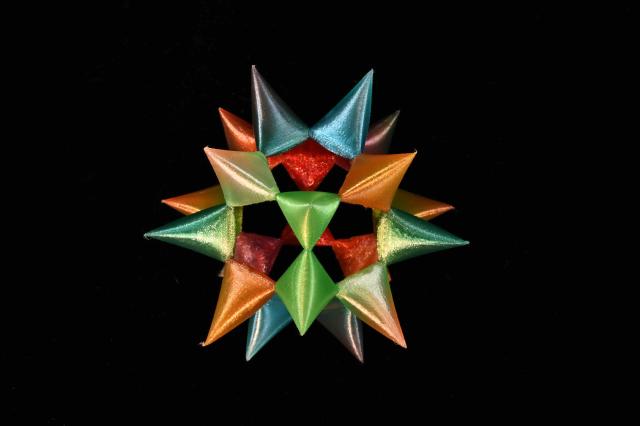
3-fold 
Uses eight colors. Rotation around opposite cones.
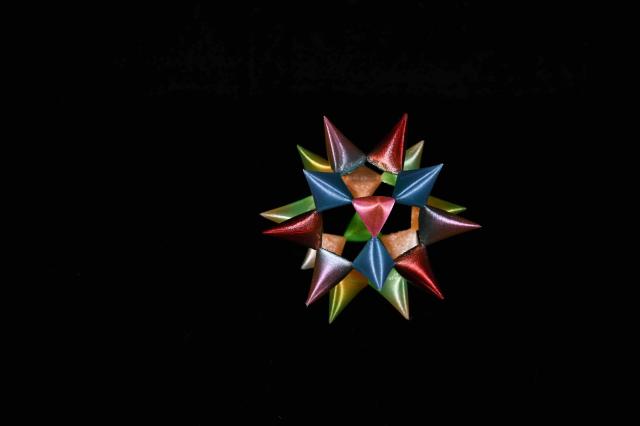
5-fold 
Uses four colors. Rotation around axes of opposite pentagons.
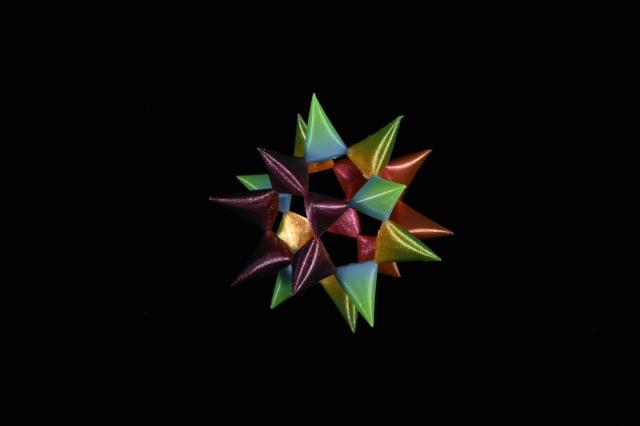
Antipodal 
Uses ten colors.
Each cone is opposite a cone of the same color. This assembly is a random 5555.
Cube 
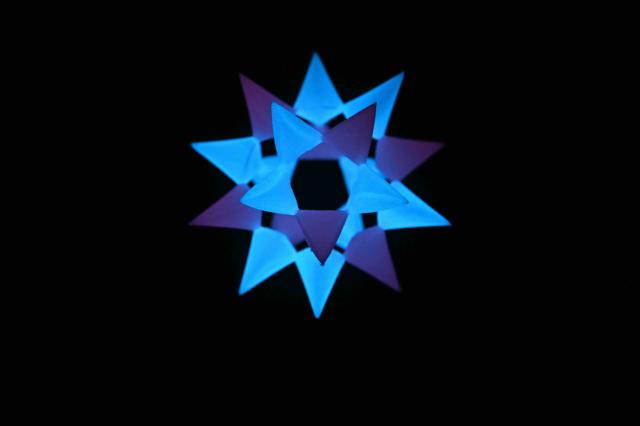
Uses two colors, and illustrates the duality of the cube and regular octohedron.
- One color (darker, pink) forms the vertices of a cube.
- The other color (brighter, blue) presents an octohedron in the nodes that join the six grouphs of two pieces.
I printed these in glow in the dark!!!
Tetrahedron 
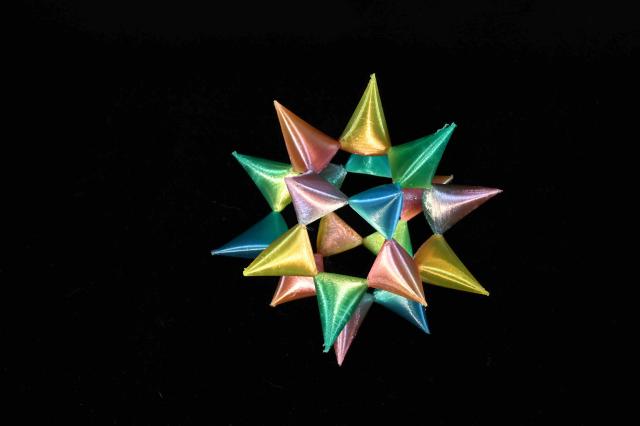
Uses five colors.
Each color forms the points of a regular tetrahedron.
About the graphs above
A graph of the symmetry generated in PlantUML. Colors are letters, number of plugs is numbers. If there are more than one of a number in a color, there’s a suffix behind an underscore. An interactive graph generated in Plotly Graph Objects. Takes a bit to load.
I used the same file for the PlantUML graph above for the interactive graphs above. I used Python’s networkx library to compute the spectral_layout of the graph, and plotly to put markers at the vertices with cones for the arrows. Yes, I know it could be better, I’m frustrated with it, too. But as of 2023-12-26, plotly.graph_objects doesn’t allow uniform sizing of Cones. Bummer, right?!?
And yes, I could use another piece of software, but I’m practicing with plotly right now, k? I teach data science courses and need to continually improve my skills in plotting libraries, and graph_objects is pretty new at this moment.