The Barth Sextic
silviana amethyst
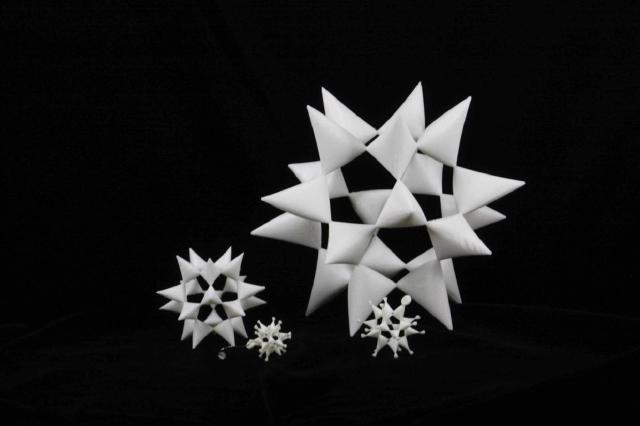
The Barth Sextic is such a cool algebraic surface!
- Nodally singular
- 20 compact pieces connected at 30 double points
- 20 non-compact pieces connected at 20 double points
- Two dodecahedra can be drawn using it
- Isocahedral / dodecahedral symmetry group
I’ve previously written about the Barth Sextic in my work blog a few times:
I’ve been obsessed with this surface since 2014, when I printed had my first one printed at the NCSU Makerspace – and it promptly broke. Ever since then, I’ve been on a quest to make the most amazing renders of it into the physical world. This electronic project was a huge step forward, in a bunch of ways.
Let me share some of it with you!
The Barth Sextic 
Maximally singular for a degree 6 surface in \(\mathbb{P}^3\), in terms of double points.
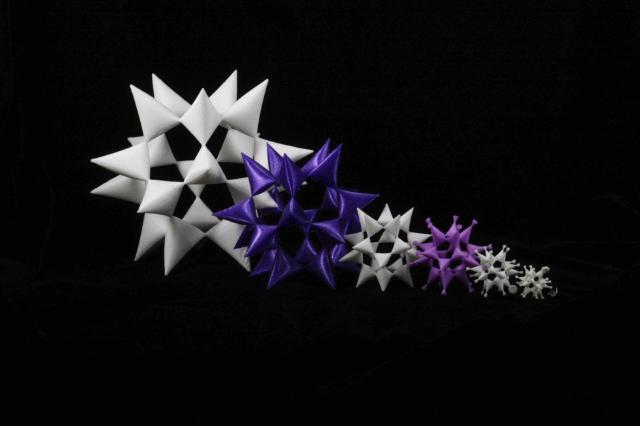
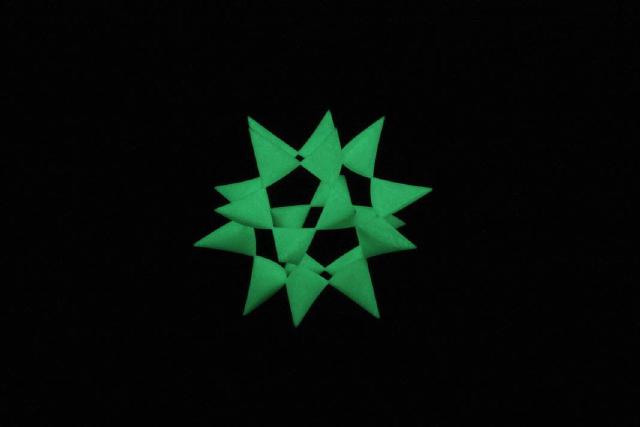
These prints vary widely in scale. The smallest is an earring, about 30mm in diameter, printed in white TPU. The largest is over 200mm in diameter, in Luminous Green PLA plastic. All were printed as one piece on my printers.
Definition 
First, I give you a 3-variable equation for the Barth Sextic. \( \phi \) is the golden ratio \( \frac{\sqrt{5}+1}{2} \). Also note the =0, so that the Sextic is the zero-set of a single polynomial.
\[ 4(\phi^2 x^2-y^2) (\phi^2 y^2-z^2) (\phi^2 z^2-x^2) - (1+2\phi) (x^2+y^2+z^2-1)^2 = 0 \]This equation is actually a simplification from the projective form, since the Sextic is defined in \( \mathbb{P}^3 \), complex three-dimensional space, in which points have four coordinates, but they are the same point if they lie on the same line. That is, a point \(x = (x_0, x_1, x_2, x_3) \in \mathbb{P}^3 \) is equivalent to another point \(y = (y_0, y_1, y_2, y_3) \in \mathbb{P}^3 \) if there exists some scalar \( c \neq 0 \in \mathbb{C} \) such that \( x = c \cdot y \). I like to think of the “extra” variable (there are four, but \(\mathbb{P}^3 \) is three-dimensional) as the “homogenizing variable” \( w \), which moves the point at infinity to be a finite point; this is when \( w = 0 \).
The projective equation for the Barth Sextic is as follows:
\[ 4(\phi^2 x^2-y^2) (\phi^2 y^2-z^2) (\phi^2 z^2-x^2) - (1+2\phi) (x^2+y^2+z^2-1)^2 w^2 = 0 \]and to recover the affine version, I set \(w = 1\). I have not played with other affine patches.